
‘Should I invest in the stock market?’, asks a student of Business English one day.
We’re sitting in Taipei 101, one of the tallest buildings in the world.
‘Sorry – what was that?’
‘Should I invest in the stock market? What do you think? Everyone else is investing and I wondered if you think I should invest?’
‘Me?’
‘Yes. What do you think?’
‘Probably not. You see, you’re asking me, and I’m an English teacher…..’

I know lots of people get financial tips from hairdressers, taxi-drivers, and shoe-shiners (yes, there are still places in the world where shoe-shiners exist, beloved of business people in expensive suits).
Call me conservative, but for some things I reckon an expert is best. If I want to get medical advice, for example, I’ll probably visit a doctor. If I want advice on constructing a skyscraper, I’ll consult a building engineer. And if I wanted financial advice, I’d probably ask a financial expert, somebody who is trained to understand the many complexities and risks of investment. I wouldn’t ask an English teacher, whose expertise lies, how can I put this, in teaching English. But radical decisions about peoples’ financial well-being are not the only thing I’m invited to give guidance on these days.
With all the advice I’m called on to dispense, sometimes I find myself forgetting what my job is. For a brief while, my actual job was teaching communication and presentation skills to business people, though a fly on the wall in many of my classes could be forgiven for missing that.
It’s nature, or is it nurture?
‘I’m thinking about giving my youngest child to my parents for a couple of years’ says another student one day.
This definitely doesn’t feel like a grammar question. This feels distinctly and very suddenly like one of those surreal dreams that you don’t tell anyone about. I clandestinely poke a fingernail into my knee to test my grip on reality. Yup, I’m awake. I wait for the next installment:
‘It’s just so difficult right now with the child so young, and me and my husband working full time. You know how many hours I work. What should I do?’ (uh-oh. There’s that question again…) ‘Which do you think is more important: nature or nurture?’
‘I really can’t answer that’ I say, ‘I have no experience’.
‘But you must have an opinion.’
‘Actually I rather think it’s 50:50’
‘That’s not an answer! You’re not answering the question!’
‘Well, all I can tell you is what my husband was told….’
‘Ah good, so it’s nature. Then I can give my child to my parents and get him back when work is calmer and he’s older and it will all be fine.
‘Wait….I didn’t say that.…’
I’m supposed to be teaching communication skills, but to be frank, the communication that time started to feel like a runaway lawn mower, charging off pell-mell down the garden, demolishing everything in its path.
Won’t somebody please ask me a simple grammar question?
As it turns out, sometimes the questions are actually more grammar based, but that doesn’t always make them less surreal.
A table is not a relationship
Consider, if you will, the student struggling to explain a story in which the main character is a family member. ‘So we sought the advice of my wife’s…. my wife’s…. my wife’s…..’ there’s an anticipation-filled pause, as he taps a word hurriedly into Google Translate.
‘……table!’ he says, triumphantly.
‘Okay….is it a relationship?’ I ask.
‘Yes.’
‘A table is not a relationship’, I hear myself saying.
Now there’s a sentence these lips have never formed before.
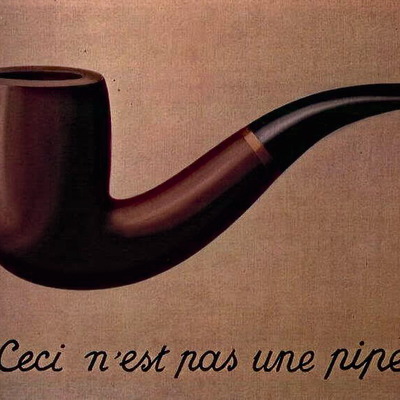
The family member, it turned out, was a cousin. Quite different from a table. But already I’m picturing a variation on the theme of René Magritte’s famous painting, This is Not a Pipe, in which a picture of a pipe is clearly not the actual pipe but merely a representation. His work explores how the label given to an image influences our experience and perception.
A Table is Not a Relationship, I think, and start to wonder how the labelling of a table affects how we experience family and furniture. I shake my head and return to the lesson.
The surrealist images returned not long after, when another thoughtful client gave me some advice at the end of our meeting: “It may be raining later. You’ll need a banana.”
I imagine myself holding a banana above my head, reflecting that, while pleasingly Dada-esque, it may fall short of my needs in the event of a deluge.
“A banana?” I ask….. and she immediately corrects herself, crushing my images of alternate reality with one word. It turns out those multi-syllable words like ‘umbrella’ and ‘banana’ tend to get muddled up. I can relate: inexplicably, the German words for ‘windscreen’ (Windschutzscheibe) and ‘expenditure’ (Aufwendung) are constantly entwined in my brain.
These grammatical quandaries remind me, delightfully, that there is always another interpretation of the world around us. Just when you think you understand everything, it starts raining and you wish you’d remembered your banana.
A frequent grammatical conversation demonstrated the importance of the humble article: ‘the’, ‘a’, and ‘an’.
A client at a large financial institution published a newsletter at the start of the Lunar New Year of the Ox: a great symbol of optimism in the financial world. The client’s headline did not have the intended impact, however, due to a key feature of Chinese grammar. Mandarin has no need of articles. You can throw nouns around, willy nilly, without any need for pesky ‘the’s, ‘a’s, or ‘an’s.
The omission in English, however, was unfortunate: ‘Taiwan’s Year of Bull’ trumpeted the headline, ‘what’s ahead for your finances?’.
What indeed? A whole year of bull sounds bad to me, but then I’m no financial advisor, as we’ve already established.